
Get Cited in ChatGPT, Perplexity, Claude, Gemini, and Google AI Overviews
GEO is a real service with a real process. We do the entity work, the structural rewrites, the third-party presence, and the monthly reporting that gets your brand quoted in AI answers, not just ranked on page one.
We Engineer Your Brand Into the Answer
A growing share of buying decisions starts as a question to an AI assistant. We track a standing set of buying-intent prompts for your category across five engines and report where you show up, month over month.
"What is the best option for someone like me?"
Based on expertise and reviews, your brand is a strong recommendation...
Search Changed. Your Strategy Has To.
AI Overviews now appear in roughly half of all Google searches. ChatGPT crossed 900 million weekly active users. Perplexity handles more than 500 million queries a month. When an AI Overview is present, click-through to the underlying websites drops by as much as 58 percent.
Your customers are getting their answers somewhere. The question is whether your brand is in the answer or not.
Brand Mentions Are the New Backlink
Ahrefs studied 75,000 brands and found brand mentions correlate roughly 3x more strongly with AI citation strength than backlinks. Your domain rating is not what gets you cited. Your presence across the web is.
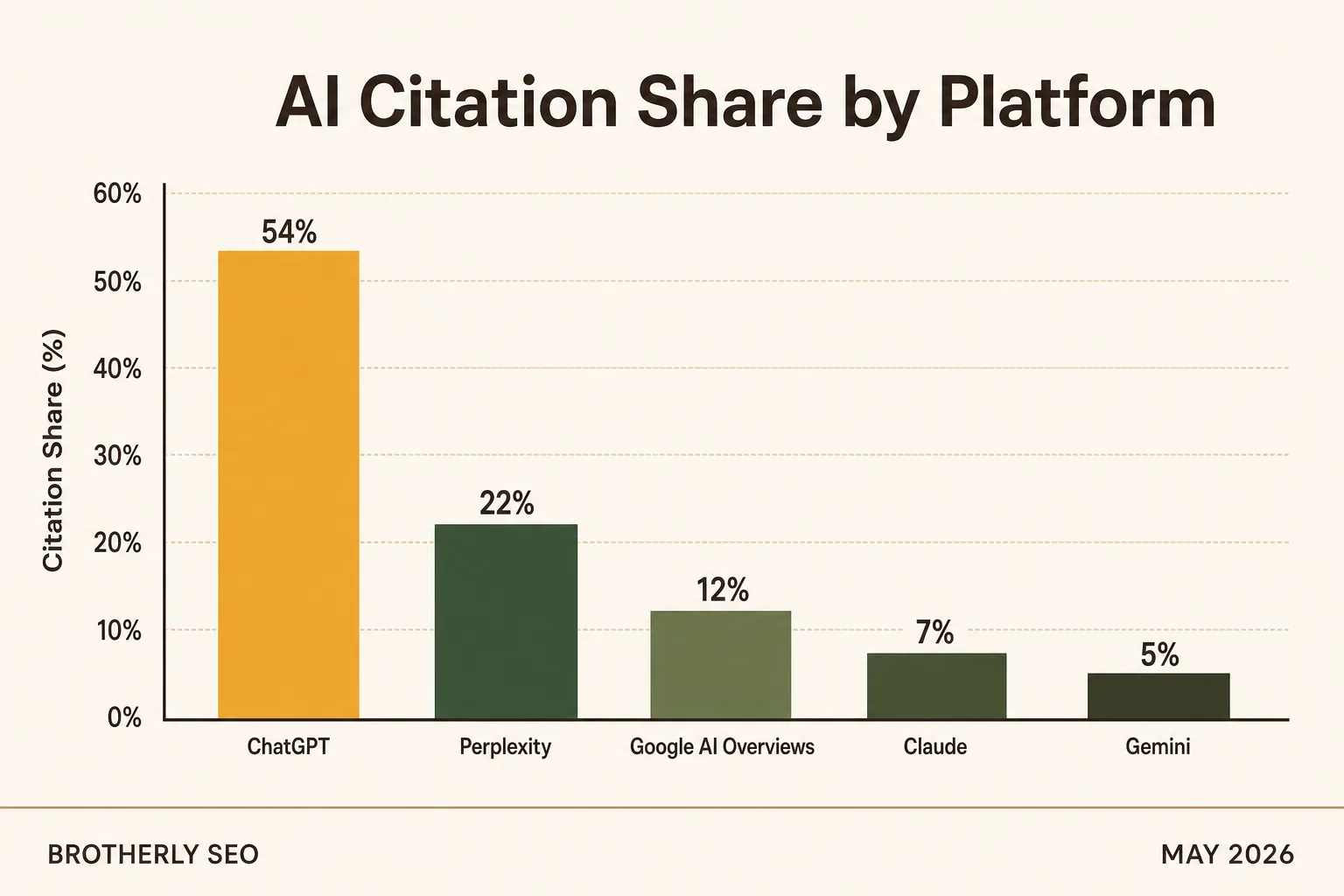
~50%
Of Google searches show AIO
Three things stopped being optional in 2026. Brand mentions are the new backlink. Author entities are a real ranking signal as of the March 2026 Google Core Update. Anonymous "team" bylines are a liability now. And content structure decides whether you get extracted. AI systems do not cite pages, they extract passages. If your key answers are buried in 400-word marketing paragraphs, the LLM cannot pull them out cleanly and will cite a competitor who structured better.
How AI Assistants Pick What to Cite
Before you can engineer for citations, you need to understand how the systems work. Three stages decide whether your brand ends up in the answer.
Crawl & Index
AI crawlers (GPTBot, ClaudeBot, PerplexityBot, Google-Extended) fetch and index your pages. If your robots.txt blocks them, you do not exist in the underlying training and retrieval corpora.
Retrieve & Extract
When a user asks a question, the system retrieves matching passages from indexed content. It extracts the cleanest, most self-contained answer it can find. Buried answers lose to structured ones.
Synthesize & Cite
The model composes its answer and attaches citations to the sources it pulled from. Brands with strong entity signals and verifiable third-party presence get cited disproportionately.
A-B-C-D: Authority, Brand Mentions, Citability, Data Signals
Think of it as E-E-A-T for AI search. These are the four signals that determine whether an LLM trusts your brand enough to cite it.
Authority
Verifiable expertise, named experts, and credentials LLMs can attribute confidently.
Brand Mentions
Weighted presence across Wikipedia, Reddit, YouTube, LinkedIn, and industry publications.
Citability
Content structured into definitions, answer blocks, tables, and stat blocks that extract cleanly.
Data Signals
Schema, sameAs links, and structured data that make every entity machine-verifiable.
The Citation Factors That Actually Get You Quoted
Brand Mention Volume
Ahrefs (Dec 2025) found mentions correlate ~3x stronger with citation than backlinks.
Author Entity Strength
Named-author credentials became a ranking signal in the March 2026 Core Update.
Content Extractability
Self-contained answer blocks of 134 to 167 words get pulled cleanly. Marketing prose does not.
Third-Party Presence
ChatGPT cites Wikipedia in ~48% of sourced answers. Perplexity pulls Reddit in ~47%.
Schema & Structured Data
Organization, Person, Service, FAQ, and Article schema make your entities verifiable.
What's Included in Our GEO Engagements
AI Visibility Audit: Know Exactly Where You Stand
We baseline your brand's citation presence across ChatGPT, Perplexity, Claude, Gemini, and Google AI Overviews against the 20 to 50 queries that actually matter for your business. You leave knowing which platforms you are losing, which competitors are winning, and why.
Citation Baseline
Five-platform query testing across ChatGPT, Perplexity, Claude, Gemini, and Google AI Overviews on your highest-intent prompts.
Competitor citation mapping to identify which brands AI assistants are currently quoting and what makes their content extractable.
Cited-source breakdown showing which third-party sites (Reddit, Wikipedia, YouTube, industry publications) are driving the citations in your space.
Crawler Access Audit
AI crawler robots.txt review for GPTBot, OAI-SearchBot, ClaudeBot, PerplexityBot, and Google-Extended.
llms.txt status check and recommendation on whether and how to deploy one.
Render and extractability audit to verify AI systems can actually parse your priority pages.
Structural Gaps
Answer-block readiness audit on top 20 pages, identifying where definitions and self-contained passages are missing.
Schema gap analysis across Organization, Person, Service, FAQ, Article, and Product types.
Entity coverage report showing which named entities (people, products, locations) need stronger signals to be recognized.
Our 5-Step GEO Process
We are not going to pretend GEO is mystical. It is a real service with five concrete phases. Here is what we actually do.
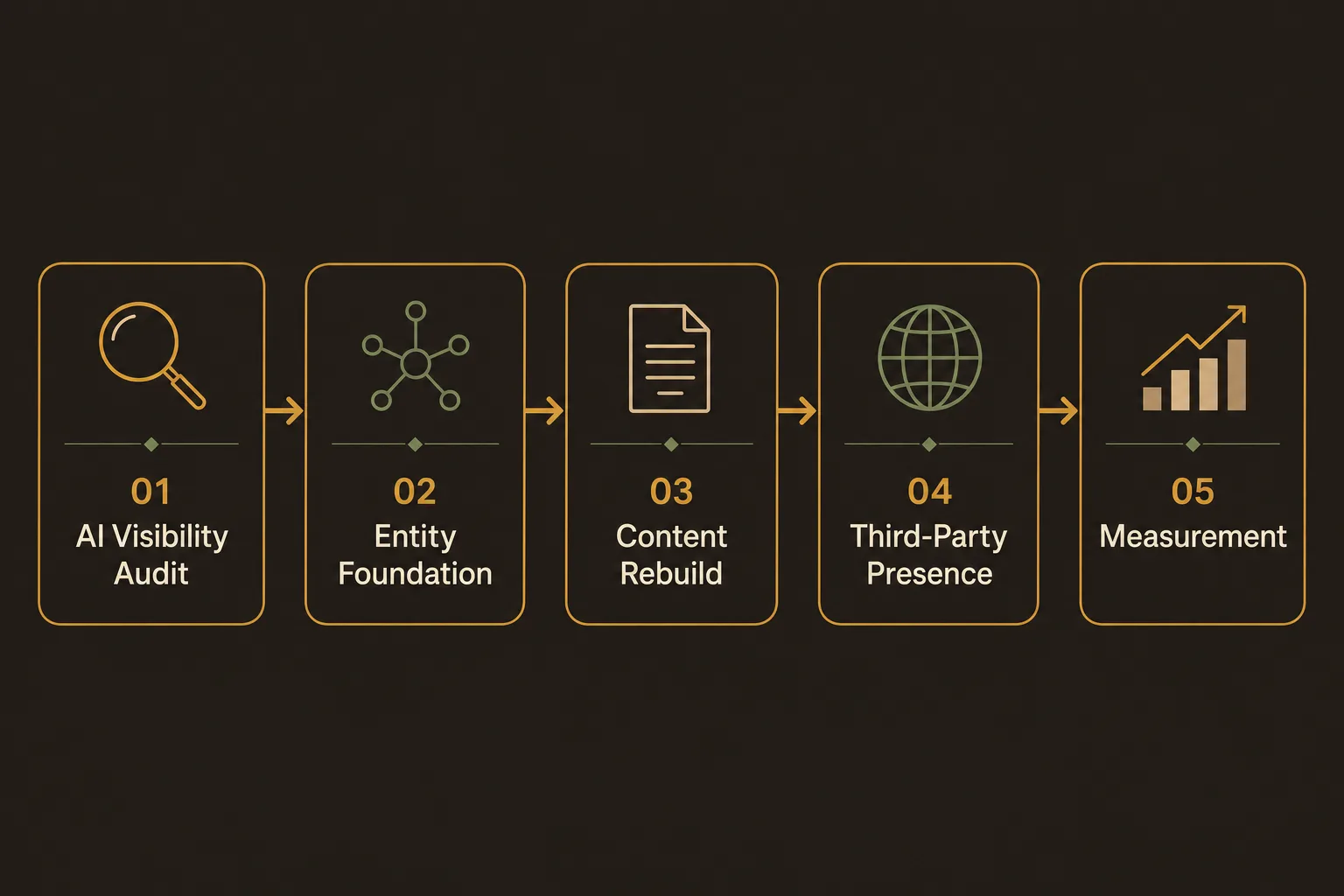
AI Visibility Audit
Baseline citation rate across ChatGPT, Perplexity, Claude, Gemini, and Google AI Overviews on the 20 to 50 queries that move your business. Map competitor citations, audit AI crawler access, and document structural gaps on priority pages.
Entity & Author Foundation
Build the entity layer LLMs verify. Organization schema, Person schema for named experts, Wikipedia and Wikidata accuracy, author bylines with credentials, and the sameAs links that tie your brand to its profiles across the web.
Content Rebuild for Citation
Restructure priority pages so LLMs can extract them. Definitions in the first 60 words, 134 to 167 word answer blocks, question-based headings, comparison tables, FAQ schema, and statistic blocks with named sources.
Third-Party Presence
Build presence where the LLMs are already looking. Accurate Wikipedia, real Reddit participation, industry roundup placements, review platform profiles, and YouTube content for the top how-to queries in your category.
Measurement & Iteration
Monthly tracking on citation rate per platform, share of AI voice, brand mention volume, sentiment, and AI-referred sessions in GA4. Quarterly content refreshes on competitive topics. Plain English reports.
When You'll Start Getting Cited
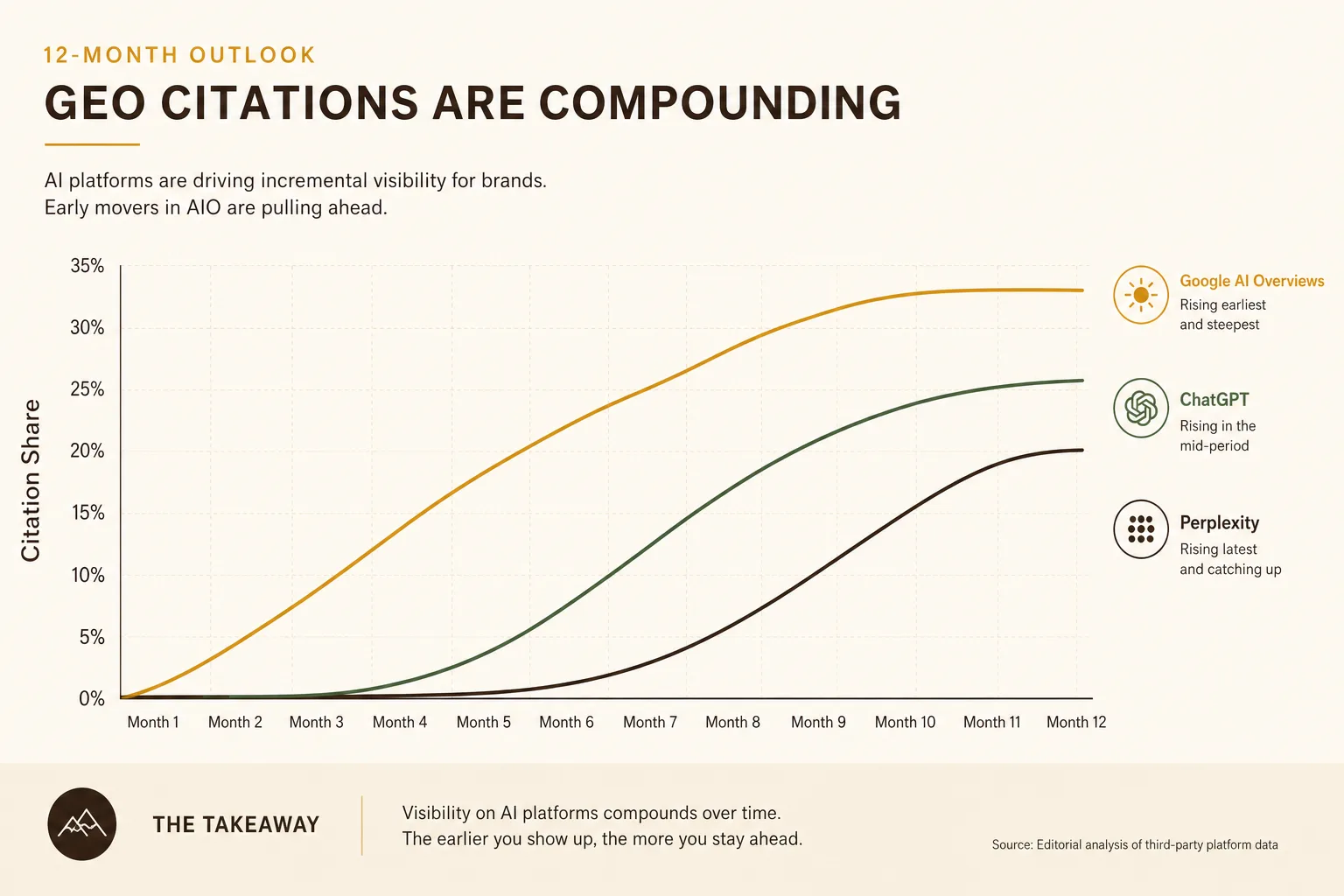
Different AI platforms ramp on different timelines. Here is a realistic curve based on what we see across engagements.
Audit & Foundation
Full visibility baseline across five platforms. Crawler access fixed. Schema and entity foundation deployed. Priority pages identified for rebuild.
Citation Rebuild
Top 10 to 20 pages rewritten for extractability. Answer blocks, definitions, comparison tables, and schema live. Author bylines and Person schema in place.
Google AI Overviews
AIO citations begin appearing. AIO is heavily influenced by traditional rankings, so brands with existing SEO foundation see movement here first.
ChatGPT & Perplexity
ChatGPT and Perplexity citations follow as third-party presence (Wikipedia, Reddit, YouTube) compounds. Share of AI voice climbs against named competitors.
Compounding Presence
Citations across all five platforms stabilize and grow. Brand mention volume reaches the threshold where LLMs default to citing you on category queries.
The bottom line: AIO is heavily influenced by traditional rankings, so brands with a healthy SEO foundation see movement there first. ChatGPT and Perplexity follow as third-party presence (Wikipedia, Reddit, YouTube) compounds. By month 8 to 12 a well-run engagement is showing measurable citation share across all five platforms.
Process-Driven. Founder-Led. Not Allergic to Data.
Brotherly SEO was founded by Christian Absher, an ASU grad with 5+ years in search. Our team brings 20+ years of combined experience across SEO, paid advertising, web design, and content strategy. GEO is a natural extension of that foundation.
We Have a Process, Not a Pitch
The category is full of "AI SEO experts" with no methodology. We have a documented five-step process we run for every client. You see it on this page, in our scope of work, and in every monthly report.
We Treat Author Entities as the Ranking Factor They Are
The March 2026 Core Update made this real. We do the unglamorous work, bylines, credentials, sameAs links, Wikipedia accuracy, that most agencies still skip.
We Report What Actually Moved
No vanity dashboards. You get citation rate per platform, share of AI voice, brand mention volume, and AI-referred sessions in GA4. If a tactic is not moving those numbers, we stop running it.
We Run GEO and SEO Together
GEO is not a replacement for SEO. Google AI Overviews still pulls roughly 92% of its citations from pages ranking in the top 10. We run them as one program because they share the same foundation.
GEO for Every Industry
Every industry has different citation patterns, competitive presence, and third-party watering holes. Our approach adapts to your specific category.
GEO FAQs
Common questions about generative engine optimization. If yours is not here, reach out. Happy to talk through it.
Ask Us AnythingGenerative engine optimization, or GEO, is the practice of getting your brand cited in answers generated by AI systems like ChatGPT, Perplexity, Claude, Gemini, and Google AI Overviews. It overlaps with traditional SEO but adds a layer of work around entity signals, content extractability, and third-party presence. It is the discipline of being citable, not just rankable.
Mostly yes. The terms GEO, AI SEO, LLM SEO, LLM optimization, and answer engine optimization (AEO) all describe the same underlying work. The industry has not fully agreed on a label. We use GEO because it is the term the major SEO publications have standardized on.
Traditional SEO gets you ranked. GEO gets you cited. Traditional SEO measures position in a list of blue links. GEO measures whether an AI assistant pulls your brand into its synthesized answer. The two stack. Good traditional SEO is the foundation. GEO adds structural, entity, and third-party work on top.
For Google AI Overviews, often within 4 to 8 weeks of the content rebuild because AIO is heavily influenced by traditional rankings. For ChatGPT and Perplexity, expect 8 to 16 weeks because their citation patterns depend more on third-party presence, which takes longer to build. We baseline on day one and report monthly so you see the curve.
Yes. GEO is not a replacement. Google AI Overviews still pulls roughly 92 percent of its citations from pages that already rank in the top 10. If your traditional SEO is weak, your GEO ceiling is low. We run them together for most clients.
Five metrics tracked monthly. AI citation rate per platform, share of AI voice against your named competitors, brand mention volume across Wikipedia, Reddit, YouTube, and LinkedIn, sentiment of those mentions, and AI-referred sessions in GA4. Plain English reports. No dashboard you have to learn.

Ready to See Where You Stand in AI Search?
Tell us about your business and the five queries you most want to own. We will run a free baseline across ChatGPT, Perplexity, Claude, Gemini, and Google AI Overviews, and show you exactly who is getting cited in your space.
Get a Free GEO Audit