
The llms.txt vs robots.txt question matters for every business owner with a website. robots.txt tells search engines which pages to crawl. llms.txt is a newer plain text file that tells large language models what to read and reference. They serve different purposes, and getting both right protects your visibility in Google and AI-powered search. Our SEO services handle both.
By Brotherly SEO Team
What robots.txt Controls (and What It Does Not)
robots.txt has been a web standard since 1994. It is a txt file that lives at the root of your domain, at yoursite.com/robots.txt. Its job is to tell search engines which pages, directories, and files they are allowed to crawl and index.
Google, Bing, and every major search engine reads this text file before touching your site. The web crawlers they operate are built to follow its rules. A disallow directive on your /admin/ folder means Googlebot stays out. A disallow on your thank-you page keeps it out of search results.
The txt robots.txt protocol has been reliable for three decades because search engines have commercial incentive to respect it. A crawler that ignored robots.txt would get banned from domains, which would make the crawler useless. That mutual enforcement is why the standard holds.
But robots.txt was built to talk to search engine bots. It was not designed to address AI systems that read your content for something other than indexing.
What llms.txt Is and How It Works
The llms.txt proposal was introduced in September 2024 by Jeremy Howard, co-founder of Answer.AI. The concept is direct: place a txt file at yoursite.com/llms.txt that tells large language models (LLMs) which content on your site is available to read, summarize, and reference.
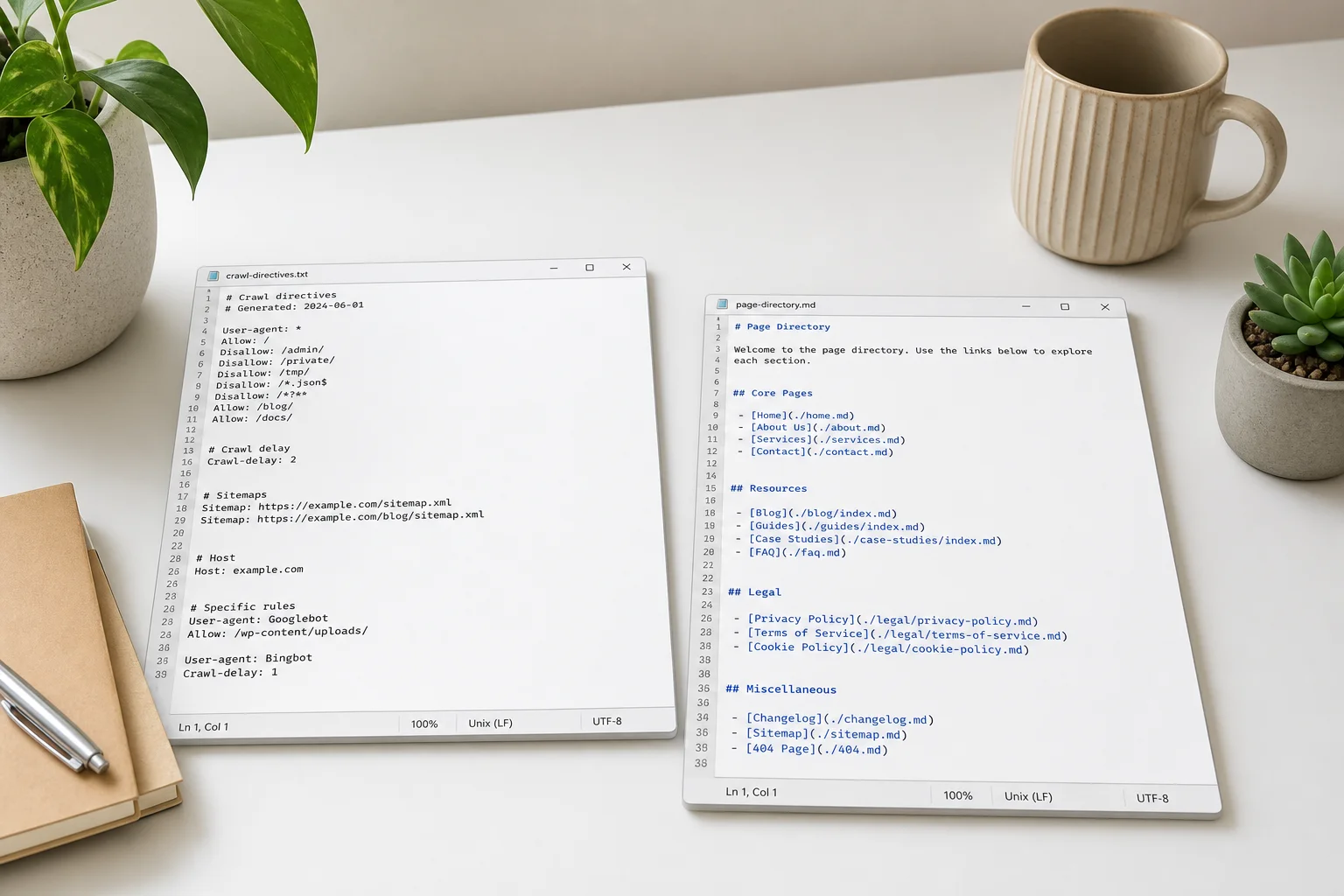
An llms.txt file uses a simple Markdown-style format. At the top is a short description of your business. Below that are links to your key pages, service descriptions, and any supporting content you want AI systems to prioritize. Think of it as a structured introduction to your site written specifically for AI readers.
Large language models like ChatGPT, Claude, and Perplexity can read this plain text file and use it to describe your business accurately when someone asks a question. A roofer with a well-built llms.txt file is more likely to be cited correctly when a homeowner types "who does emergency roof repair in Phoenix?" into an AI tool.
The llms.txt file is not yet a formal internet standard. There is no regulatory body that forces AI systems to comply. But the major AI companies building consumer-facing tools are beginning to treat it as a signal for what content the site owner wants cited. Adoption is moving fast.
llms.txt vs robots.txt: How These Two Files Differ in Practice
The llms.txt vs robots.txt comparison comes up constantly now, and the differences are sharper than most people expect.
robots.txt is enforceable. The search engines that built their businesses on indexing the web have strong incentive to respect it. If you disallow a URL, Google will not index it. The relationship is direct and consistent.
llms.txt is advisory. Large language models llms training happens on data that was crawled before your file existed, and there is no rollback mechanism. Going forward, AI crawlers that access your site in real time are increasingly checking llms.txt, but compliance is voluntary right now.
robots.txt controls access now. llms.txt shapes how AI systems represent your business over time.
Both are plain text files in your site root. Both are small, fast to update, and readable by anyone. But they operate in separate ecosystems with different rules, and treating them as interchangeable is a mistake we see regularly.
There is also a third layer that many miss: some AI crawlers, like OpenAI's GPTBot, check your robots.txt file for AI-specific disallow rules. You can block GPTBot in robots.txt while keeping your standard Google rules intact. That gives you granular control over who gets in. The llms.txt file is a separate signal that works alongside robots.txt, not instead of it.
Why Service Businesses Have a Real Decision to Make Right Now
Here is the situation as it stands for a plumber in Phoenix or a landscaper in Denver.
A growing portion of your potential customers are using AI tools as a starting point for research. They type questions into ChatGPT or Perplexity instead of Google. They ask "who handles HVAC installation in my city with same-day quotes?" and they act on what comes back. That answer is shaped by the content AI systems can access and trust.
If your robots.txt accidentally blocks AI crawlers and you have no llms.txt file, you are invisible in that channel. If your llms.txt is missing or vague, the AI summarizes your business incorrectly or skips you entirely. If you have blocked AI crawlers to protect content but have not set up an llms.txt for what you do want cited, you get the worst of both.
Our local SEO work now includes an audit of both files because AI-powered search is already affecting who calls whom. Industries like home services, healthcare, and professional services are seeing real traffic from AI-generated referrals. The businesses that get their llms.txt vs robots.txt strategy right now have a head start that compounds.
What Goes Wrong When These Files Are Neglected
Getting robots.txt wrong is the faster-moving problem. A single bad directive can block Google from crawling your core service pages. We have seen this firsthand with clients who had no idea their site was partially deindexed. Traffic dropped, leads dried up, and the fix was a small change to a text file no one had reviewed in years.
Getting llms.txt wrong is slower but still costly. If you have no llms.txt file and your site content is thin or disorganized, AI systems that reference your domain may produce vague or inaccurate descriptions. A potential customer gets the wrong information and calls someone else.
The combined risk is this: most business owners assume robots.txt governs everything related to web access. They set it once and forget it. But large language models llms systems operate in a separate space that robots.txt was never built to address. A site can have a perfectly clean robots.txt and still be described incorrectly by ChatGPT because there was no llms.txt to guide it.
There is also a legitimate case for using your llms.txt to steer AI systems away from content you do not want cited: draft pages, internal pricing, or process documentation. That is a deliberate choice that belongs in your strategy, not something left to chance.
Frequently Asked Questions
Does robots.txt block AI crawlers like ChatGPT from reading my site?
It can, but only for real-time crawling going forward. OpenAI's GPTBot respects robots.txt disallow rules when crawling live content. However, content already used to train the base model is not retroactively removed. To block specific AI crawlers, you need user-agent-specific rules in your robots.txt targeting GPTBot or ClaudeBot. The llms.txt file does not perform the same blocking function.
Is llms.txt a Google ranking factor?
As of May 2026, Google has not confirmed that llms.txt affects traditional search rankings. Its primary value is visibility in AI-powered tools like ChatGPT, Perplexity, and Bing Copilot that pull live web content. That said, the structured content you create for your llms.txt file often improves site clarity, which can support how search engines categorize and rank your pages.
Can I copy my robots.txt format into an llms.txt file?
No. They use completely different formats. robots.txt uses directives like User-agent, Disallow, and Allow in plain text syntax. llms.txt uses a Markdown-style layout with a business summary and links to your key pages. Copying one format into the other produces a file that serves no purpose and may confuse the systems trying to read it.
What if my website only has a few pages? Do both files still matter?
Yes. Even a small three-page service site benefits from a reviewed robots.txt and a properly built llms.txt. The robots.txt ensures Google can crawl what you want indexed. The llms.txt gives AI systems a clear description of what you do and where to send someone. Small sites often suffer most from AI misrepresentation because there is less content for the model to cross-reference.
How often should these files be updated?
robots.txt should be reviewed any time you restructure your site, add major sections, or change platforms, and at minimum once a year for active sites. llms.txt should be updated when you add new service pages or shift your core offerings. Both files are small and fast to update. The real risk is assuming they are done once and need no further attention.
Make Sure Your Site Is Set Up for How Customers Search Today
Most service businesses are running on a robots.txt file that has not been reviewed in years and have no llms.txt file at all. That combination quietly costs visibility in both traditional search and AI-powered tools. We audit both files, fix what is broken, and build the strategy around where your customers are actually going. Start with a free consultation and find out exactly where your site stands.
Want us to do this for you?
Brotherly SEO builds and runs the strategy described here for service businesses across the country.
Book a free consultation