
Arizona solar companies are losing qualified leads to two AI search queries every single day. When a homeowner asks ChatGPT, Perplexity, or Google's AI Overviews which installer to call in Phoenix or Tucson, your business won't appear unless it's built for generative engine optimization. Here is what that gap looks like in practice and why it compounds every month you ignore it.
By Brotherly SEO Team
How AI Search Shifted the Rules for Solar Lead Generation
For the past decade, solar leads in Arizona came through two main channels: Google Maps and organic search results. Homeowners typed something like "solar panel installation Phoenix" or "Arizona solar company reviews," saw a ranked list, and called whoever showed up at the top.
That model still works. But it is no longer the whole picture.
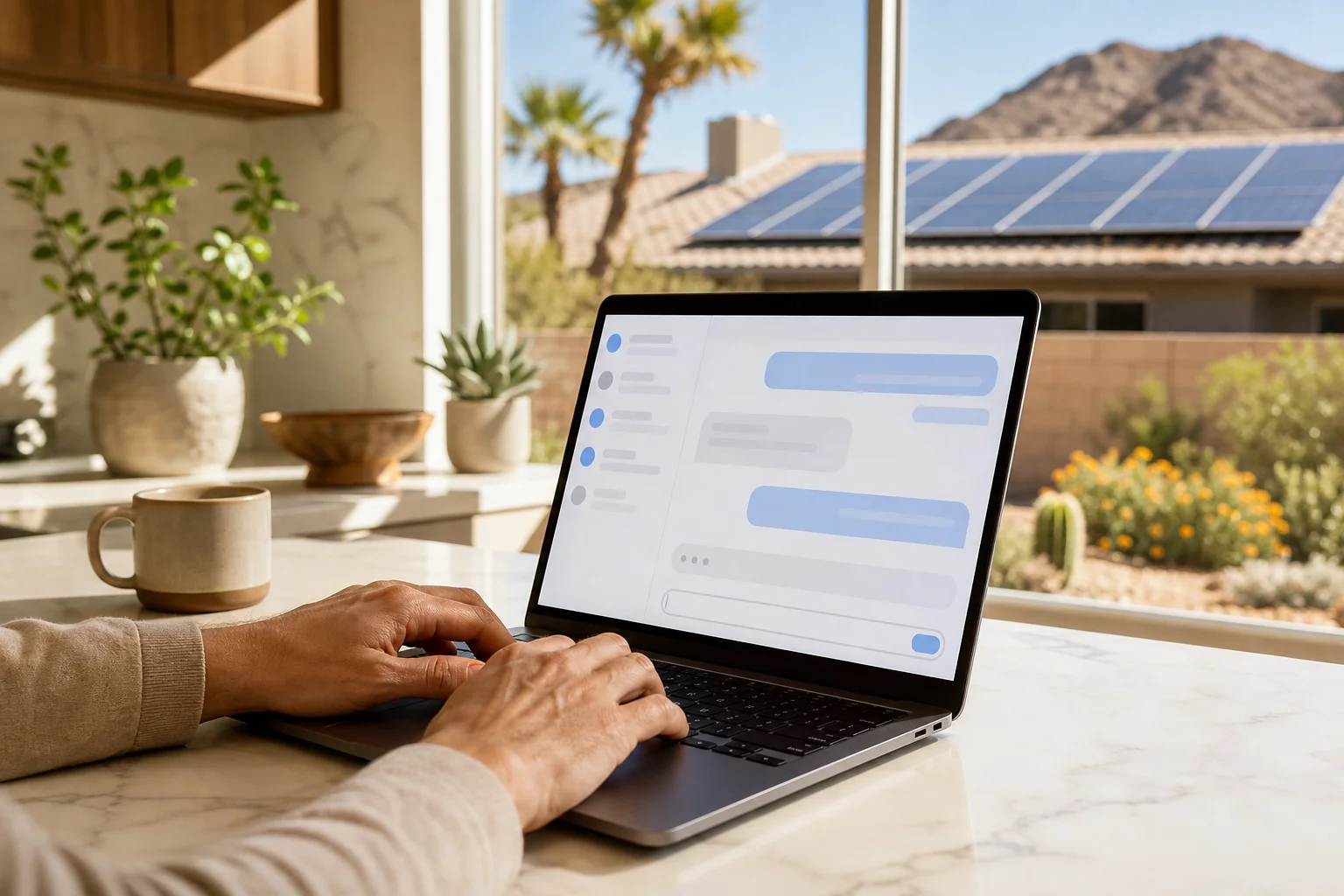
A growing share of homeowners now start their research by asking a question directly to an AI tool. They type "What's the best solar company in Scottsdale?" into ChatGPT or into Google's AI Overview, read the generated response, and call the company that gets mentioned. They never click a link. They never scroll a results page. They read a paragraph answer and act on it.
If your business is not being named in those answers, you are invisible to that buyer, and the buyer does not know you exist.
For arizona solar companies competing in a high-adoption market like metro Phoenix, Tucson, or the East Valley, that invisible gap compounds fast. Two specific query types account for most of that loss, and they are different enough that they require different solutions.
The First Query You're Losing: Conversational Comparison Searches
The first query type is the conversational comparison. This is when a homeowner has not decided on a company yet and asks an AI tool to help them make the call.
Common examples of this type include:
- "Which solar companies in Arizona have the best reputation?"
- "Who installs solar panels in Tempe and how do I know they're legitimate?"
- "What should I look for when hiring a solar installer in the Phoenix area?"
These queries are different from traditional Google searches because the AI does not return a list of links for the user to browse. It generates a paragraph-style answer that either names specific companies or describes the qualities a buyer should look for. The homeowner reads that paragraph and moves forward based on what the AI recommended.
The companies that show up in these AI-generated responses tend to share a few consistent traits. They have detailed, consistent review content across Google, Yelp, and industry-specific platforms. They have clear service area language spread across multiple pages of their site. And they have content that directly addresses the comparison questions an AI tool is likely to pull from when forming a response.
Most arizona solar companies have not built any of that with intention. Their websites describe service offerings, show project photos, and ask visitors to request a quote. That is not enough for an AI to confidently name them as a top recommendation in a comparison response. The AI cannot extract a signal of authority or specificity from a thin services page.
The businesses showing up are the ones who made it easy for AI to find something worth quoting.
The Second Query You're Losing: Research Questions That Drive Purchase Intent
The second query type is more common and even less obvious. These are the research questions homeowners ask before they have even started thinking about which company to call.
Examples include:
- "How much do solar panels cost in Arizona?"
- "Is solar worth it if you have an APS bill over $200 a month?"
- "How long does solar take to pay for itself in Phoenix?"
- "What solar incentives are available in Arizona in 2026?"
When a homeowner asks one of these in Google's AI Overview or a chat tool, the AI pulls its answer from published content it considers authoritative on that topic. It cites websites that answered these questions clearly, specifically for Arizona, and in enough depth that the AI can extract a complete, accurate response.
Here is the problem: most arizona solar companies do not have content that actually answers these questions. They have a homepage, a services page, a contact form, and maybe a few thin posts. Nothing that signals to an AI, "this is the authoritative source for what solar costs in Phoenix."
The companies that do have that content get cited. Their name gets attached to the AI's answer. The homeowner reading that response forms a mental association between that company and credibility before visiting any website at all.
That association is what drives the first call. And most solar businesses in Arizona are not building it.
What AI Tools Are Actually Pulling From Your Website
Understanding how AI search engines pull content helps explain why most solar company websites are not being cited in generated answers.
AI tools like Google's Search Generative Experience and the models behind Perplexity and ChatGPT are designed to extract structured, specific answers. They prefer content that directly matches the phrasing of a user's question. They prefer content that includes specific geographic signals. And they weight content that has been cited by or linked from other reputable sources in the same topic space.
A page that says "We are a trusted solar company in Arizona, call us today" gives an AI nothing it can use. A page that says "Homeowners in Phoenix with APS bills over $200 a month typically see a payback period of 6 to 10 years under current net metering rates" gives an AI something it can quote, cite, and build an answer around.
This is why the solar marketing strategy we build for clients always starts with content architecture, not just keyword targeting. You need pages structured to supply clear answers to the questions your buyers are actually asking AI tools, not just pages optimized for a handful of broad search terms.
The gap between those two content approaches is where most arizona solar companies are currently losing ground without realizing it.
Why Your Google Rankings Are Not Enough for Arizona Solar Companies
Some solar businesses rank well in organic search and assume that means they are covered. It does not, for one straightforward reason: AI Overviews and chat-based answers do not reliably pull from the top-ranked organic result. They pull from whatever source best answers the specific question being asked.
A company that ranks first for "Phoenix solar installation" might still be completely absent when a homeowner asks "how do I choose a trustworthy solar installer in Phoenix." Those are two different queries with two different content requirements. Ranking well for one does not guarantee visibility in the other.
Research published by SparkToro in 2024 found that zero-click searches account for more than 58 percent of all Google searches in the United States, with AI Overviews accelerating that trend. For service businesses like solar installers, that means a growing portion of buyers form their purchase preferences before visiting any company website. By the time they call, the decision is often already made.
Traditional search optimization targets ranking positions in the standard results. AI search requires a parallel content strategy focused on answering specific questions in formats that AI tools can extract, quote, and attribute to your business. Both matter, but if you are only running one of those playbooks, the other channel is wide open for your competitors to take.
Frequently Asked Questions
How does AI search affect Arizona solar companies specifically? Arizona has among the highest residential solar adoption rates in the country and a crowded installer market. When AI tools respond to comparison questions, businesses with well-structured, Arizona-specific content get named. Companies without that content lose the visibility entirely, often before a homeowner has visited any website or made a single phone call.
What are the two AI search queries Arizona solar companies are losing? The first is conversational comparison queries, where homeowners ask AI tools to help them choose an installer. The second is research queries about costs, payback periods, and state-specific incentives. Both require specific content structures for your business to appear in the generated answers those tools produce.
Is AI search optimization different from traditional SEO? Yes, in meaningful ways. Traditional SEO targets keyword rankings in the standard results page. AI search optimization focuses on structuring content so that AI tools can extract clear, specific answers and attribute them to your business. The technical foundations overlap, but the content strategy requires a different approach.
Can a small Arizona solar company compete against large national brands in AI search? Yes. AI tools do not always favor the largest company. They favor the clearest, most specific answer. A regional installer with well-organized, Arizona-specific content addressing actual buyer questions can outperform a national brand that publishes generic material without geographic depth.
How long does it take to appear in AI-generated search answers after making content changes? It depends on your domain's existing authority and how competitive the specific query space is. Content improvements can start showing in AI-generated answers within 4 to 12 weeks. Businesses with stronger existing authority and a broader content base tend to see results at the faster end of that range.
Get Your Solar Business Into the AI Answers Arizona Buyers Are Reading
If you run a solar company in Arizona that ranks well but still feels like leads are slipping away without explanation, AI search visibility is likely a significant part of the answer. We audit where your content falls short, identify which queries your competitors are capturing, and build the content structure that puts your business into those generated responses. Review our process to see how we approach this work, then reach out when you are ready to close that gap.
Want us to do this for you?
Brotherly SEO builds and runs the strategy described here for service businesses across the country.
Book a free consultation