
The 2026 AI search citation playbook for service businesses is about one shift: when someone asks an AI tool which company to hire, you want to be the cited answer. From ChatGPT Perplexity to Google's AI Overviews, these systems pull from the same types of credible sources. Our SEO services are built to get you into them.
By Brotherly SEO Team
Why Traditional SEO Alone Is No Longer Enough
Traditional SEO was built around Google search. Rank on page one, get traffic, convert that traffic into calls. That model still works, but it covers a shrinking share of how people find service businesses today.
A growing portion of queries now go through AI-powered interfaces. Users ask which pest control company in their city has the best reviews. They ask which roofer handles their neighborhood. Google's AI Overviews, ChatGPT, and Perplexity answer those questions directly and pull cited businesses above organic results. The businesses in those citations are getting calls. The ones that are not are invisible in that layer entirely.
Traditional SEO and generative engine optimization are not competing strategies. You need both. But if your strategy was built entirely around ten blue links, you are missing the fastest-growing channel in search today.
How AI Search Engines Choose Their Citations
AI search engines do not rank pages the way traditional search engines do. They ingest structured, credible data and build a knowledge layer they reference when generating answers. For service businesses, the question is not just "do I rank" but "am I a source AI systems trust enough to cite."
The signals AI systems weight most heavily:
- NAP consistency: your business name, address, and phone number match across all directories
- Schema markup: structured data that makes your services machine-readable
- Google Business Profile: verified, complete, active, with recent reviews
- Content specificity: pages that answer exact questions in plain, complete sentences
- Third-party mentions: Yelp, industry directories, publications, and community threads that reference you by name
The breadth of your footprint across all of these signals matters as much as any single one.
The Signals That Get Service Businesses Cited
NAP Consistency and Directory Coverage
Your business name, address, and phone number must be identical across all directories. One outdated suite number or a slightly different business name creates data conflicts. AI systems treat consistency as a trust signal. Conflicting citations lower that trust and reduce the chances you get cited.
Audit your listings across Google, Yelp, Apple Maps, Bing Places, and every relevant industry directory. Clean up the conflicts. Fill in the missing fields. It is not glamorous work, but it compounds.
Schema Markup and Structured Data
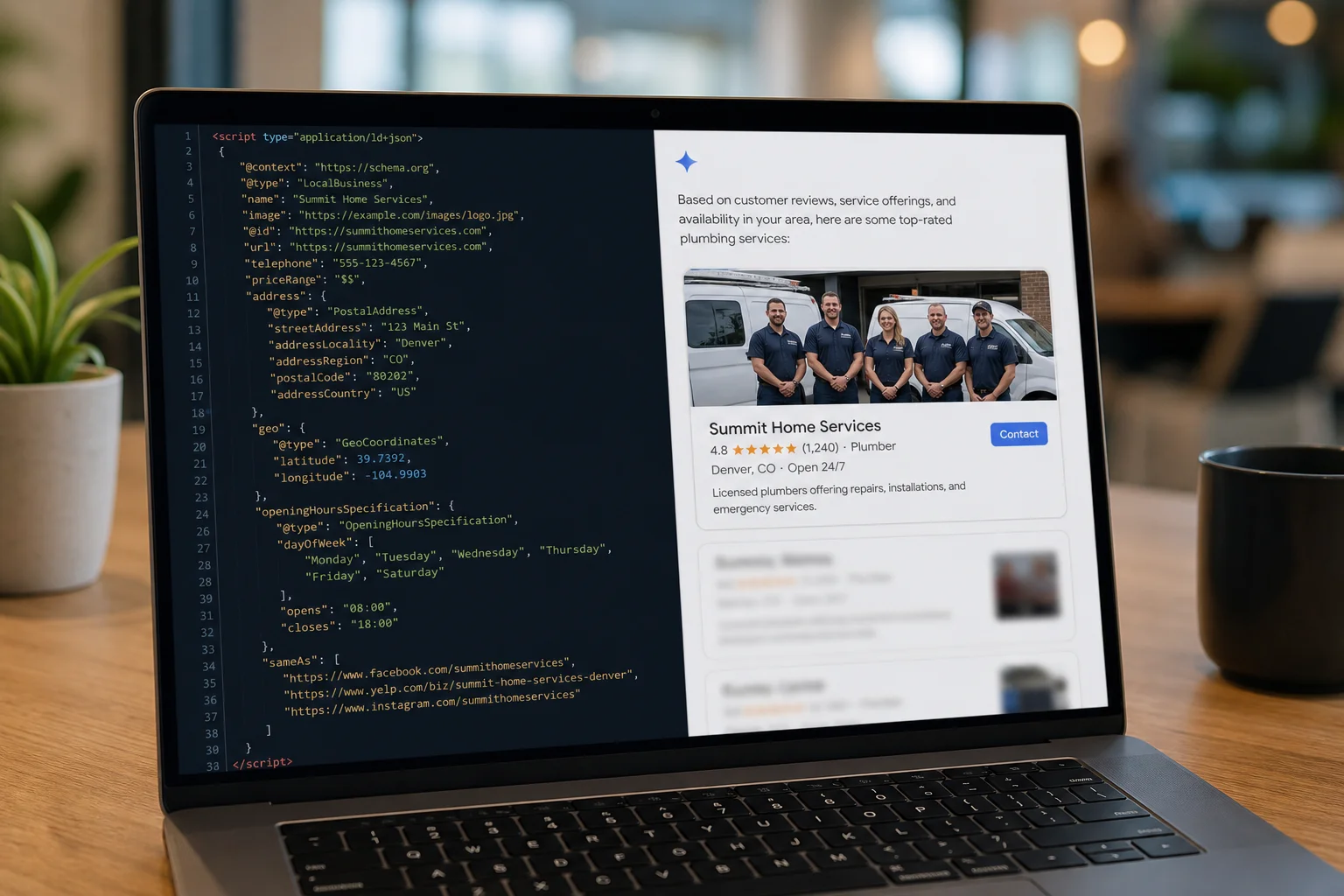
Schema markup is code added to your website that tells search engines and AI systems exactly what your business does and where it operates. LocalBusiness schema, Service schema, and Review schema are the baseline for any service business. Without this structured data layer, AI engines have to guess. They often guess wrong or skip you entirely.
Structured data also powers rich features in traditional search engine results: star ratings, FAQ entries, and service lists. It works across both the traditional and AI search layers simultaneously.
Google Business Profile Activity
Your Google Business Profile is one of the primary data sources Google's AI Overviews draw from for local queries. An incomplete or stale profile is a weak signal. Active businesses post updates, respond to reviews, answer the Q&A section, and keep their category and attribute data current. That consistent activity signals relevance across all the local AI systems Google uses.
Technical SEO: The Foundation Everything Else Builds On
None of the AI citation work matters if your site has foundational technical problems. AI systems and traditional search engines both depend on clean crawlability, fast load times, and proper indexing.
The technical SEO baseline for any service business before building a citation strategy:
- Site speed under three seconds on mobile
- No crawl errors or orphaned pages
- Clean canonical tags to prevent duplicate content signals
- Sitemap submitted to Google Search Console and actively crawled
- URL structure that maps cleanly to your service categories
We run a full technical SEO audit before touching citations or content for any client. A citation strategy on a slow, poorly-indexed site produces nothing. Our local SEO work follows this same sequence in every market: technical first, citations second, schema third, content fourth.
How We Execute the 2026 AI Search Citation Playbook for Service Businesses
The 2026 AI search citation playbook for service businesses is something we run as an integrated service, not a checklist we hand off. Here is the sequence:
Citation audit. We pull your existing directory data and map every inconsistency: NAP conflicts, missing listings, wrong categories. We fix them at the source.
Schema implementation. We add LocalBusiness, Service, and Review schema across all relevant pages. For clients with FAQ content, we implement FAQ schema to make those pages directly citable by AI systems.
Google Business Profile rebuild. We audit every field: categories, attributes, service lists, photos, Q&A, and post history. We fill every gap and build an active posting cadence.
Content audit and refresh. We find the pages that should be answering specific questions and are not. We rewrite them to answer clearly and completely, in plain language, with FAQ schema where appropriate.
Citation monitoring. We track AI Overview appearances and third-party citation volume over time so you can see the work compound.
This is not complicated work. It is thorough work. Most service business owners do not have time for thorough. That is the job we show up to do.
FAQ Schema and Conversational Content
FAQ schema is one of the most direct signals you can send to AI search engines. When you mark up a question-and-answer pair with proper schema, you are telling AI systems exactly what question a page answers and what that answer is. Generative AI tools are built to answer questions. Content structured this way gets pulled into citations more often.
The questions to target are the ones your prospects actually type. Google search data, Reddit threads in your industry, and the "People Also Ask" section all surface what your market is asking. Build your content around those questions. Add FAQ schema markup to the pages where those answers live. Do this across all service pages, location pages, and relevant blog posts.
This is not only a traditional SEO tactic. It is a direct pipeline into AI citation results. A question answered completely and clearly in properly marked-up content is exactly what generative engine results want when they reference service businesses.
Frequently Asked Questions
What is the difference between traditional SEO and generative engine optimization?
Traditional SEO focuses on ranking pages in Google search results. Generative engine optimization targets the AI layer that generates answers above or instead of those results. Both matter in 2026. Traditional SEO builds your ranking floor. Generative engine optimization gets your business cited by ChatGPT, Perplexity, and Google AI Overviews when someone asks a direct question about your service category.
How does FAQ schema help with AI search citations?
FAQ schema marks up your content with structured question-and-answer pairs that AI systems can read and cite directly. When your service pages include properly implemented FAQ schema, AI tools can pull your specific answers verbatim. It is one of the most direct technical levers for improving citation visibility across all content types on your site.
Does my Google Business Profile affect AI Overviews?
Yes. Google's AI Overviews pull heavily from Google Business Profile data, especially for local queries. An incomplete profile, outdated hours, or missing service categories reduces your chance of appearing in AI-generated local results. Active profiles with recent reviews, regular posts, and complete attribute data perform significantly better in local AI search.
How long does it take to start appearing in AI citations?
Businesses with clean technical SEO and consistent citations typically start appearing in AI Overview results within 60 to 90 days of adding schema markup and refreshed content. Businesses with more foundational issues take four to six months. There is no shortcut, but there is a clear sequence that produces results.
Do third-party sources like Yelp affect AI citations?
Yes. ChatGPT, Perplexity, and other AI engines draw from a wide range of third-party sources including Yelp, Apple Maps, industry directories, and publications that mention your business by name. The broader your citation footprint across these sources, the more data AI systems have to confirm your business as a credible answer.
Get Your Business Into the AI Citation Pool
If competitors in your market are showing up in AI Overviews and you are not, that is a solvable problem. We run citation audits, fix the technical gaps, and build the content layer AI engines want to source from. You do not need to understand every piece of how this works. You need a team that does it for you. Start with a free consultation and we will map out exactly where your citation gaps are and what it takes to close them.
Want us to do this for you?
Brotherly SEO builds and runs the strategy described here for service businesses across the country.
Book a free consultation