
Author entity signals are now a ranking factor, and that shift changes how Google evaluates who publishes content, not just what the content says. If your business publishes blogs, Google Search is increasingly checking whether the author behind those posts is a real, verifiable expert with a documented record online. Our SEO services now treat author credibility as a core deliverable.
By Brotherly SEO Team
What "Author Entity" Actually Means
In search engine terminology, an entity is any real-world person, place, organization, or concept that Google can identify and cross-reference across the web. Author entities are people, and Google uses data points from LinkedIn profiles, bylines, published articles, speaking credits, and structured markup to determine whether an author is who they claim to be.
Google's Knowledge Graph aggregates information about entities across the web and has tracked them for years. What changed in 2025 and 2026 is how aggressively Google uses those entity signals to score content quality, especially in competitive verticals where trust matters. A blog post written by an unverified, nameless team member carries less weight than one linked to a credible expert Google can confirm.
This is the foundation of E-E-A-T: Experience, Expertise, Authoritativeness, and Trustworthiness. The Experience addition, made by Google in 2022, signaled that demonstrated, real-world track records matter. Author entity signals are how Google operationalizes that standard at scale.
How Google Ranking Is Affected by Author Signals
One of the most significant shifts in ranking factors Google has made is connecting content quality scores to author credibility. Google Search does not just read your content. It cross-references the byline against known entities in its Knowledge Graph and across the broader index.
Specifically, Google uses several corroborating data points to build an author entity profile:
Byline Consistency
If a named expert publishes on your site and also maintains a LinkedIn profile, a trade publication byline, and a podcast appearance, those sources corroborate each other. Google recognizes the same entity across sources through entity recognition. If your author name is listed as "Admin" or changes post to post, no entity recognition is possible.
Person Schema Markup
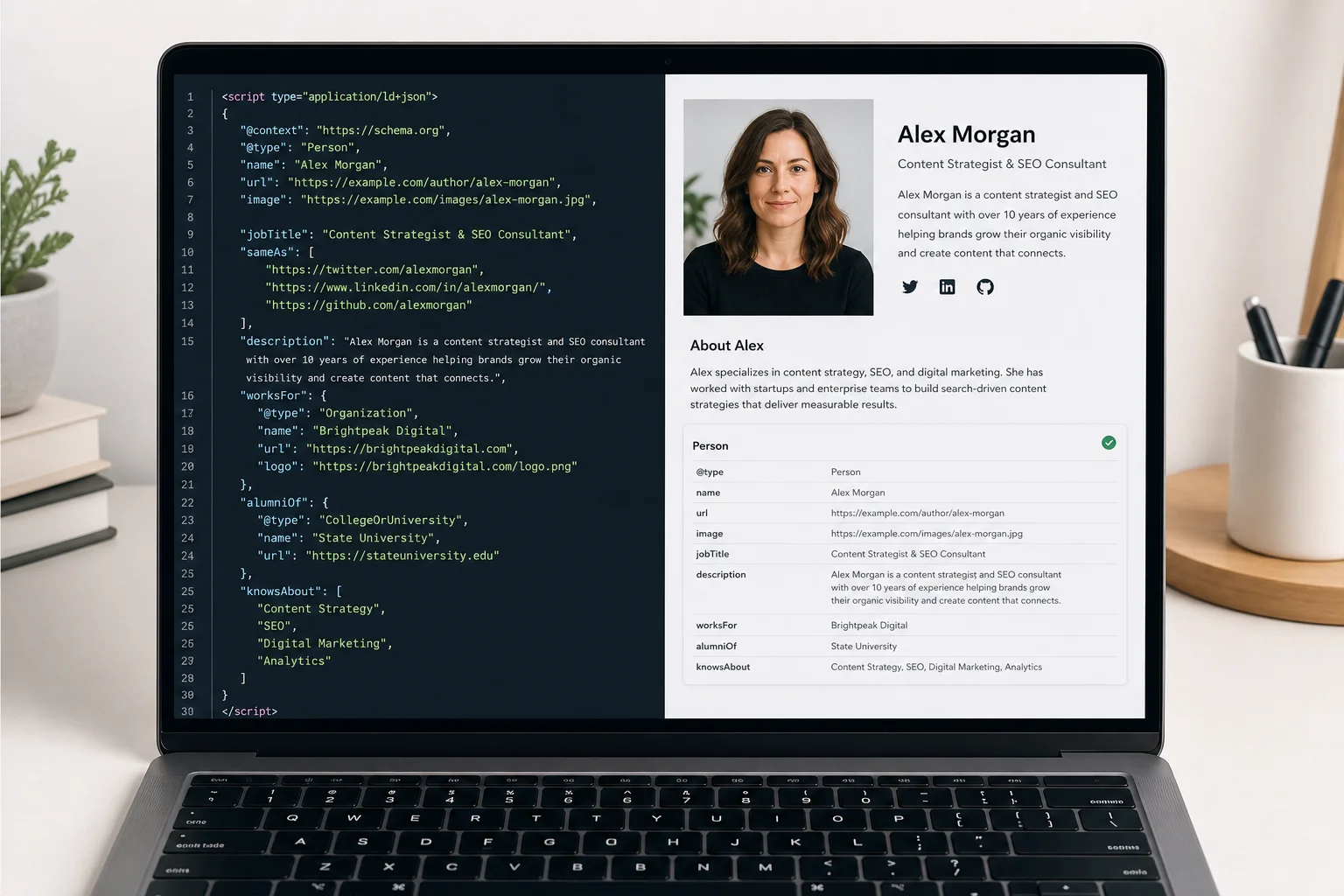
Structured data matters significantly here. Person schema markup on author pages gives search engines structured information about who wrote a piece of content, what their credentials are, where they work, and what other content they have published. Without schema markup, Google has to infer those connections. With it, entity recognition becomes direct and explicit rather than estimated.
Publisher Corroboration
Google also evaluates whether the publishing domain itself is associated with known entities. A dentist's blog that links to the author's verified credentials from a recognized professional organization builds more trust than one where the author has no verifiable presence anywhere online.
Why This Matters for Business Owners Publishing Content
Most small business websites publish blogs under generic bylines: "Staff Writer," "Marketing Team," or no byline at all. That was acceptable in 2018. It is a liability now.
Google AI Overviews are pulling citations from sources Google considers authoritative. If your content is not tied to a verifiable author entity, it is far less likely to appear in those AI Overviews as a citation. The businesses dominating search results right now are increasingly the ones whose authors have real, documented footprints online.
This connects directly to topical authority. Topical authority is the concept that a site demonstrates consistent expertise across a cluster of related topics rather than publishing in isolation. Author entities reinforce topical authority because they signal that a real expert is consistently covering a domain.
Traditional user experience signals like page engagement and dwell time remain important ranking factors, but author entity signals add a credibility layer that behavioral metrics alone cannot provide. Google is combining both to form a fuller picture of content quality and source reliability.
If you work with a Phoenix HVAC company, every blog published under a named expert with verifiable industry credentials builds more entity signal than a hundred anonymous posts ever could.
What the March 2026 Core Update Made Clear
The March 2026 Core Update was the clearest signal yet that ranking factors Google applies to content are shifting toward author and entity-level evaluation. Sites with strong topical coverage but weak author signals saw measurable ranking declines. Sites with clear, verifiable authorship and consistent schema markup held steady or improved.
Google Search Console data from clients we work with showed a consistent pattern. Pages with author schema, linked author bios, and consistent bylines maintained impressions and click-through rates. Pages with anonymous bylines in the same content clusters saw ranking drops, even when the content quality was comparable by traditional on-page measures.
This aligns with findings reported in Search Engine Journal in 2025 and corroborated by practitioners tracking algorithmic shifts across competitive verticals. The direction is clear: author entity signals are a ranking factor, and they carry growing weight relative to traditional signals like keyword density and backlink volume.
Our link building work now includes author citation building as a standard component, because an author mentioned and linked to from credible external domains strengthens that entity profile in a measurable, lasting way.
Building an Author Entity Profile That Google Trusts
Getting this right is a multi-channel effort, not just adding a person schema block to a WordPress page. Here is the strategic picture:
Consistent Bylines Across Every Channel
The author name on your site should match exactly what appears on your Google Business Profile, LinkedIn, guest posts, podcast profiles, and press mentions. The one most important audit you can run right now is checking every published piece for byline consistency. Fragmented or inconsistent bylines break entity recognition and dilute the entity profile Google is trying to build.
Author Bio Pages with Structured Data
Every author on your site should have a dedicated bio page. That page should include their expertise, specialization, links to off-site profiles, and Person schema markup. Schema markup is the structured data layer that makes entity recognition straightforward rather than guessed. Without it, Google has to infer the connection between the byline name and the real person behind it.
Off-Site Citations and Mentions
Backlinks help rankings broadly. Author mentions tied to a verifiable person entity are especially useful for building entity signals. A business owner quoted in a local publication with their name and credentials gives Google a reliable cross-reference point. Over time, those citations create an entity profile that search engines recognize and trust with increasing confidence.
Google Search Console Monitoring
Google Search Console shows which queries your content ranks for and how individual pages perform over time. After implementing author entity updates, monitor for ranking movement on content pages, particularly in competitive informational query clusters. Improvement in impressions on those pages typically indicates Google is gaining more confidence in the entity signals behind your site.
Frequently Asked Questions
What are author entity signals in SEO? Author entity signals are data points that search engines use to verify and evaluate the real-world identity of a content author. They include byline consistency across the web, structured data like Person schema markup, off-site citations and mentions, and corroborating profiles on third-party platforms. Google uses these signals to assess the trustworthiness and expertise of the people producing content on a given site.
Does Person schema markup really affect Google ranking? Person schema markup alone does not guarantee a ranking improvement, but it makes entity recognition significantly easier for search engines. When Google can confirm who wrote a piece of content and cross-reference that author against trusted sources, the content is more likely to be treated as authoritative. Schema markup is the structured data layer that makes verification explicit rather than inferred.
How do author entity signals connect to Google AI Overviews? Google AI Overviews pull citations from sources Google considers reliable. Author entity signals are a key factor that establishes that reliability. Content from verified, credible author entities is more likely to surface as a citation in AI Overviews than content with no verifiable author behind it. This makes author credibility a direct lever for AI overview visibility.
Can small businesses build author entity signals without a recognizable brand name? Yes. The process starts with consistent bylines, a properly structured author bio page with Person schema markup, and building off-site mentions through guest posts, press coverage, and industry directories. Business owners with genuine expertise and documented credentials can build strong entity profiles over time, independent of brand size or national recognition.
What is topical authority and how does it connect to author entities? Topical authority is Google's assessment of how comprehensively a site covers a subject area. Author entities reinforce topical authority by showing that a real expert with verifiable credentials is consistently producing content within a domain. The combination of topical depth and author credibility sends a stronger quality signal to search engines than either factor produces alone.
Let Us Build Your Author Entity Profile
If your site is publishing content without a verified author entity behind it, you are leaving ranking factors on the table that your competitors may already be capturing. At Brotherly SEO, we handle the full process: author bio pages, person schema implementation, citation outreach, and byline audits. You do not need to sort this out on your own. See exactly how we approach it at our process page.
Want us to do this for you?
Brotherly SEO builds and runs the strategy described here for service businesses across the country.
Book a free consultation